FIRE with a BV or holding company
Do you have a BV or holding company? Then every euro you take out of it is subject to corporate income tax (vennootschapsbelasting, vpb) and box 2 tax. FIRE Dashboard Pro works out over how many years you can best pay out, and gives you a report to discuss with your accountant.
In short
- Of €100,000 profit in your BV, you keep €61,155 after vpb and box 2 in 2026 at the low rate, and €55,890 at the high rate.
- Paying out over several years keeps you in the low box 2 rate (24.5%) more often. The best number of years depends on your return, your spending and box 3 on your personal wealth.
- The cabinet wants to lower box 2 to 23.5% and 29% in 2027–2030, and the limit on borrowing from your own BV in five steps from €500,000 to €100,000. This is in the amending bill (novelle) of 3 November 2026, a proposal that is not yet law.
- Pro includes your BV in the growth projection, the drawdown planner, the Monte Carlo simulation and the withdrawal order, and makes a report for your adviser (PDF).
What happens to a euro from your BV
Money in your BV is not yet yours. The BV pays vpb on its profit, including interest and capital gains on the investments it holds. When you pay out, you personally pay box 2 tax on the dividend. What you paid into the BV yourself, your paid-in capital, does come back without box 2 tax.
| €100,000 profit in your BV | Box 2 low (24.5%) | Box 2 high (31%) | Plan low (23.5%) | Plan high (29%) |
|---|---|---|---|---|
| Vpb (19%) | −€19,000 | −€19,000 | −€19,000 | −€19,000 |
| Dividend | €81,000 | €81,000 | €81,000 | €81,000 |
| Box 2 | −€19,845 | −€25,110 | −€19,035 | −€23,490 |
| Net to you | €61,155 | €55,890 | €61,965 | €57,510 |
Vpb is 19% on profit up to €200,000 and 25.8% above that, in 2026 and 2027. Box 2 is 24.5% up to €68,843 per person in 2026 (€69,607 in 2027 under current law) and 31% above that. With a tax partner (fiscale partner), each of you has your own bracket. On profit up to €200,000, you therefore pay 38.8% to 44.1% tax in total before a euro reaches your personal account.
Paying out in one go or over several years
How you pay out makes a big difference. An example: your BV holds €400,000 in retained earnings, on which vpb has already been paid, and you are single. Under current law the bracket limit in 2027 is €69,607. With the cabinet plan we use €68,843: the 2027 tax plan, as passed by the House of Representatives on 12 November 2026, freezes the box 2 bracket limit at its 2026 level from 2027 to 2031. The Senate still has to vote.
| Paying out €400,000 | Box 2 | Net |
|---|---|---|
| In one go in 2027, current law: €69,607 at 24.5% and €330,393 at 31% | €119,476 | €280,524 |
| In one go in 2027, with the cabinet plan: €68,843 at 23.5% and €331,157 at 29% | €112,214 | €287,786 |
| Four years of €100,000 in 2027–2030, with the cabinet plan | €100,855 | €299,145 |
| Six years of €66,667, all at the low rate, current law | €98,000 | €302,000 |
| Six years of €66,667 in 2027–2032, with the cabinet plan: four years at 23.5%, then two at 24.5% | €95,333 | €304,667 |
Spreading it out below the bracket limit saves €21,476 here compared with everything in one go. The cabinet plan makes both cheaper, but spreading it out still saves more. In reality, what stays in the BV keeps growing and pays vpb on that return. What you move to your personal wealth falls under box 3. That is why the app works it out year by year. There is more in Drawing down your BV or holding company when you stop working.
What the drawdown planner shows
In the drawdown planner, BV drawdown in tranches, you choose over how many years you empty the BV from your FIRE date. Each year the BV sells an equal share of what is still in it and pays it out. That year's profit is a separate tax base for vpb, and that year's dividend for box 2. This way you use both low brackets again every year.
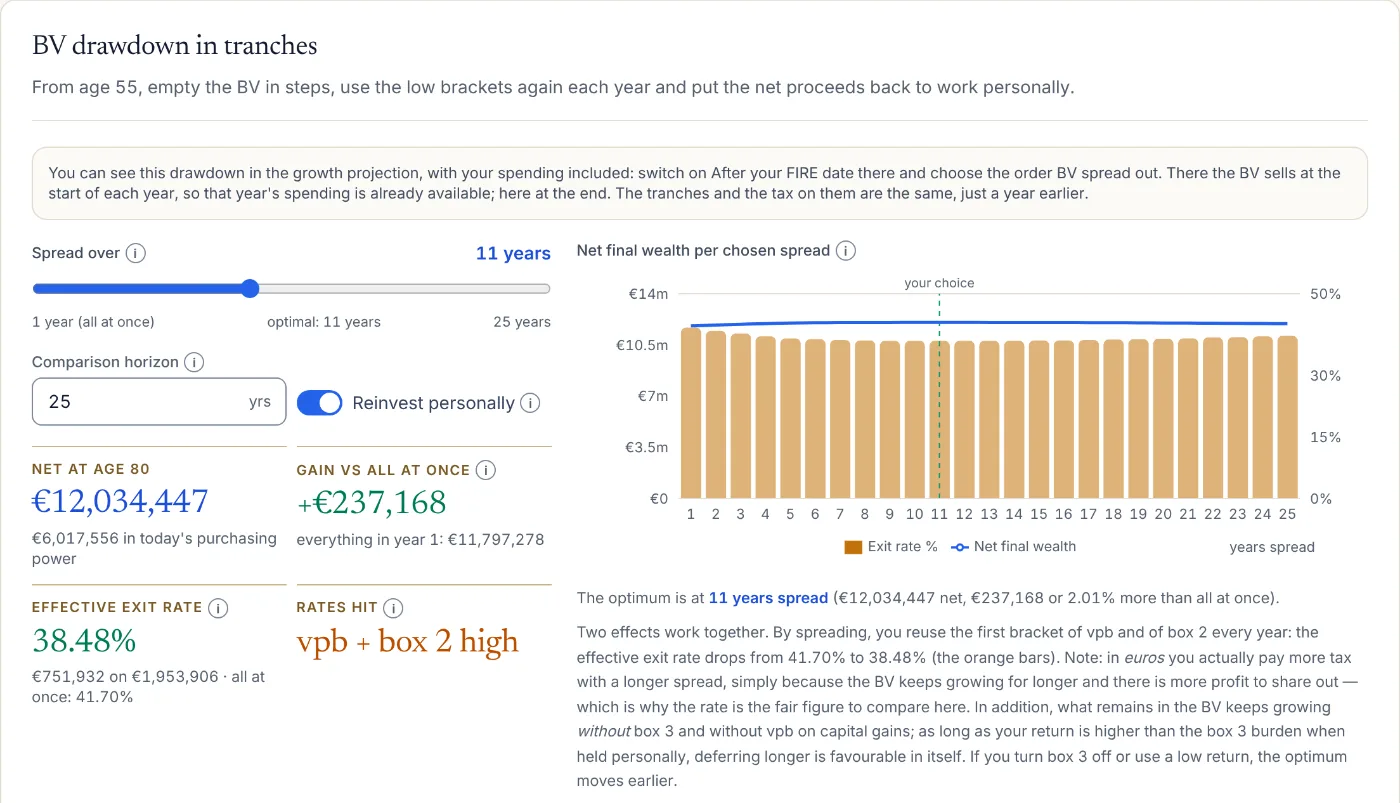
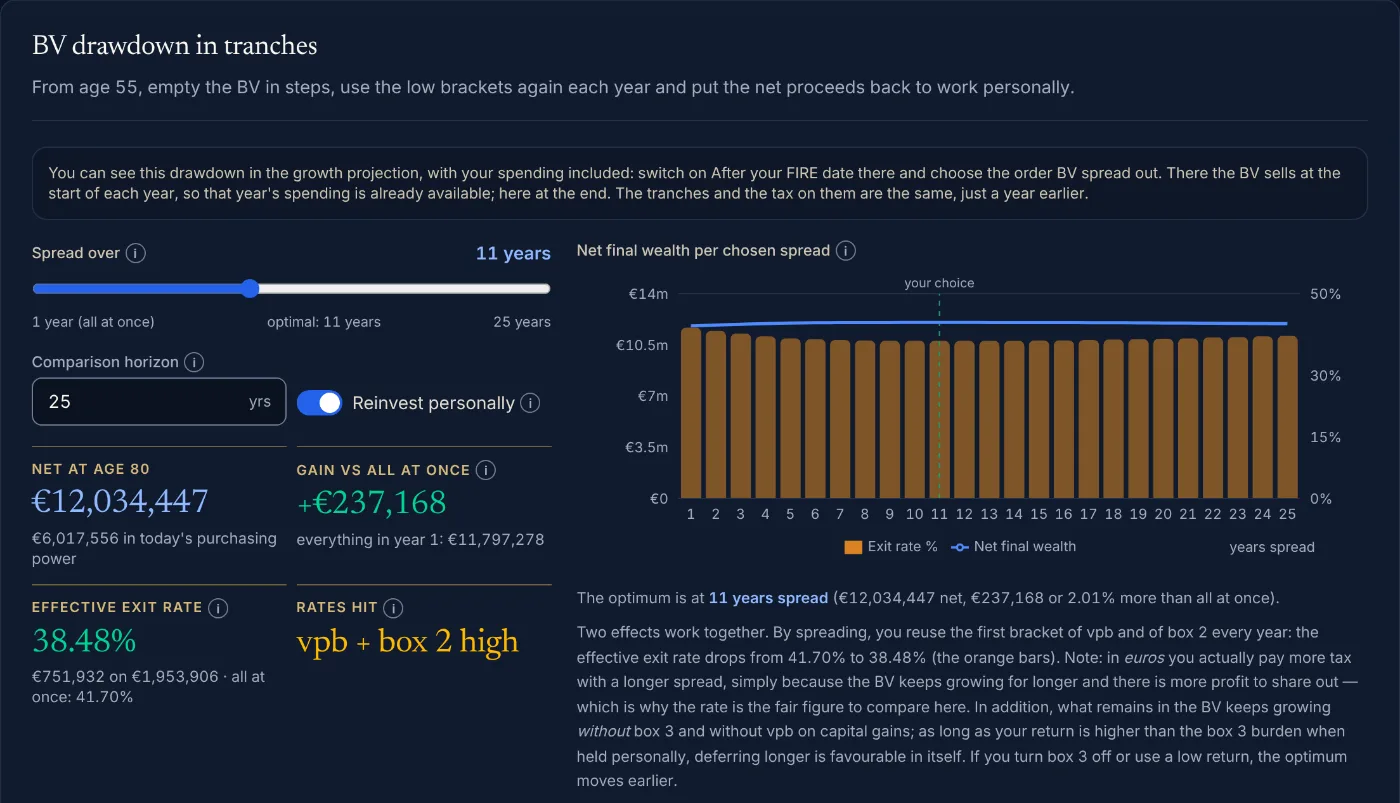
- The optimum. For every spread from 1 to 25 years, the app works out your net wealth on the same end date, and shows which spread leaves you the most.
- The effective exit rate. Vpb plus box 2 as a percentage of what you take out of the BV. In euros, a longer spread can mean more tax, because the BV keeps growing for longer. That is why the rate is the fair figure to compare.
- Which brackets you reach. Whether in any year you go above €200,000 profit for vpb or above the box 2 bracket limit.
- Year by year. A table with what the BV sells, the gain, the vpb, the dividend, the box 2 tax, what goes to you net, and what is left in the BV and in your personal wealth.
The planner takes your paid-in capital and the purchase value of your investments into account: capital gains on an ETF in the BV only pay vpb when the BV sells. Not included are, among other things, the customary salary (gebruikelijk loon) and the option of keeping the BV and investing from it.
The box 2 plans as a scenario
Amending bill (novelle) of 3 November 2026 (parliamentary paper 37053), a proposal. Not yet law.
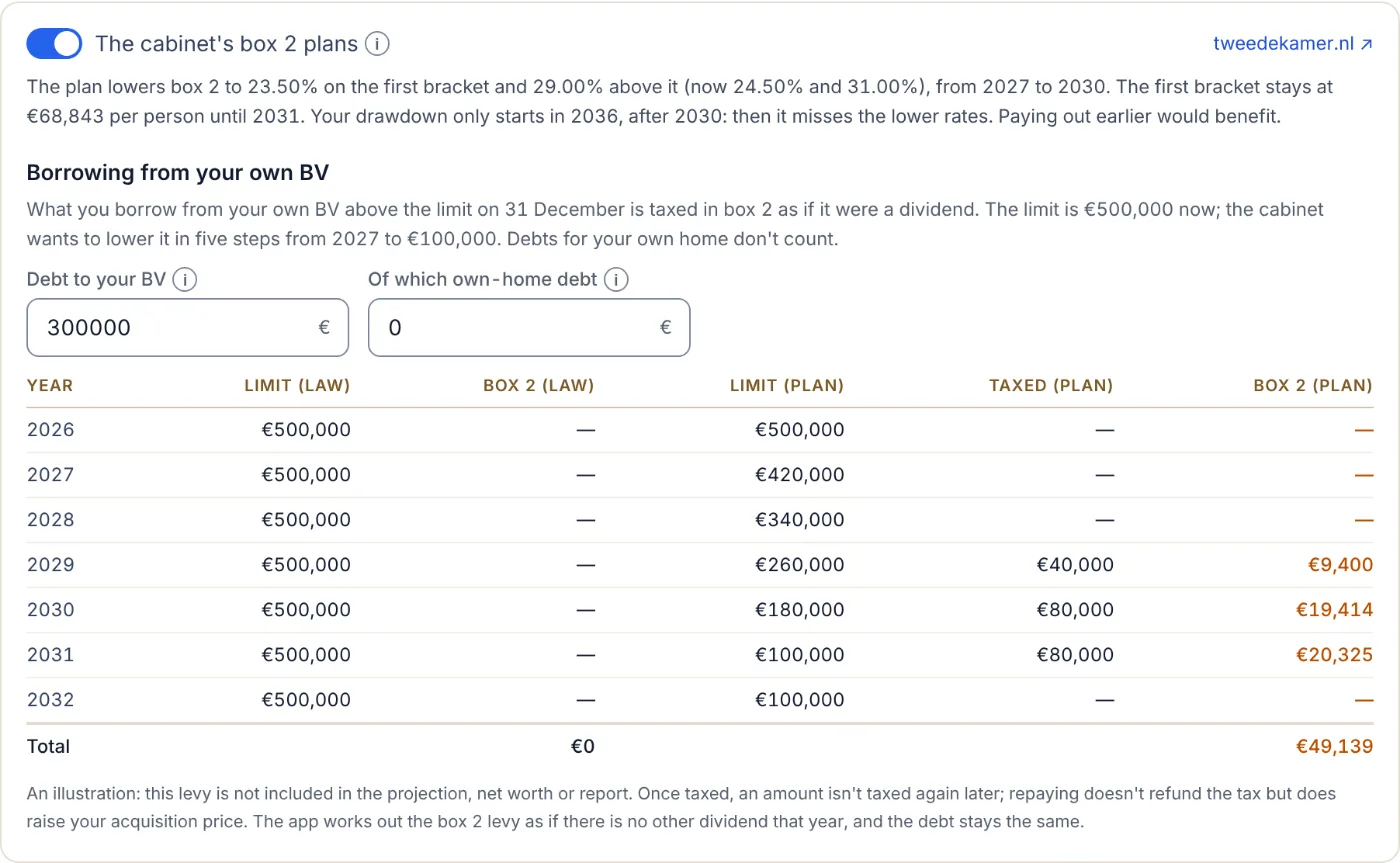
The cabinet wants to lower box 2 from 2027 to 2030 inclusive: the first bracket from 24.5% to 23.5%, and the top rate from 31% to 29%. From 2031 the rates are 24.5% and 31% again. It also wants to lower the limit on borrowing from your own BV. What you and your tax partner together borrow from your own BV above that limit on 31 December is taxed in box 2 as if it were a dividend. A loan for your own home does not count.
| Year | Limit now | Limit in the plan |
|---|---|---|
| 2026 | €500,000 | €500,000 |
| 2027 | €500,000 | €420,000 |
| 2028 | €500,000 | €340,000 |
| 2029 | €500,000 | €260,000 |
| 2030 | €500,000 | €180,000 |
| 2031 | €500,000 | €100,000 |
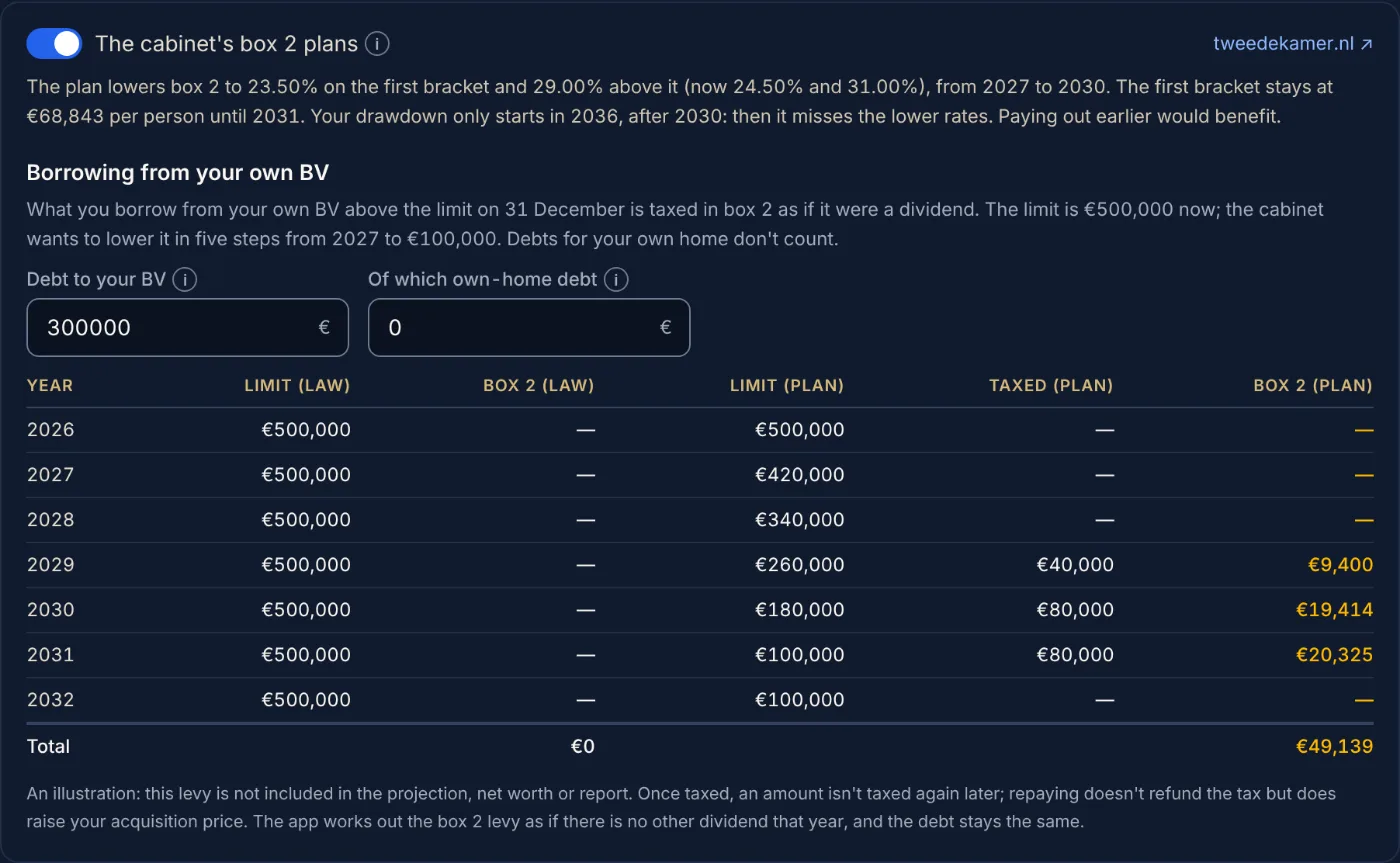
Pro puts both plans next to current law. With the scenario switched on, the projection and the drawdown use 23.5% and 29% in 2027–2030. For the loan, you enter what you owe the BV, and the app shows per year what falls above the limit and what that costs in box 2. If you borrow €300,000 from your BV, then under the plan €40,000 falls above the limit in 2029, and another €80,000 in each of 2030 and 2031. Together that costs €49,047 in box 2, if you have no other dividend that year and the debt stays the same.
Watch the year in which your drawdown starts. If you stop working after 2030, your drawdown falls outside the years with the lower rates, and the app says so. If you pay out earlier, you do benefit.
Your BV as its own pot in the Monte Carlo simulation
A simulation that treats all your wealth as personal wealth is too optimistic with a BV: it does not see the vpb and box 2 tax when you withdraw. With Pro, the Monte Carlo simulation keeps your personal wealth and the BV apart. Box 3 applies to your personal wealth only. What you withdraw from the BV comes to you as a dividend, after vpb on the capital gains of what the BV sells and box 2 on the dividend. Rebalancing happens within each pot, and the stress tests use the same two pots. How that works exactly is explained in Monte Carlo with a BV.
Withdrawal order: which pot first?
After your FIRE date you live off your wealth. Do you use your personal wealth first, or dividends from the BV? The withdrawal order in Pro compares Private first, BV first and BV spread out, and Lijfrente as a bridge if you have a lijfrente (a Dutch annuity). For each order you see what is left at an age you choose, after all the tax still in it, and how much tax goes with it.
Which order wins depends on your situation. In the sample report below, BV spread out comes out best: the BV goes to your private wealth in eleven equal parts, so each year's payout stays smaller and more of it falls in the low box 2 rate. BV first comes second. The comparison is simplified: each year the expected return per pot, without ups and downs.
Your portfolio: personal and the BV side by side
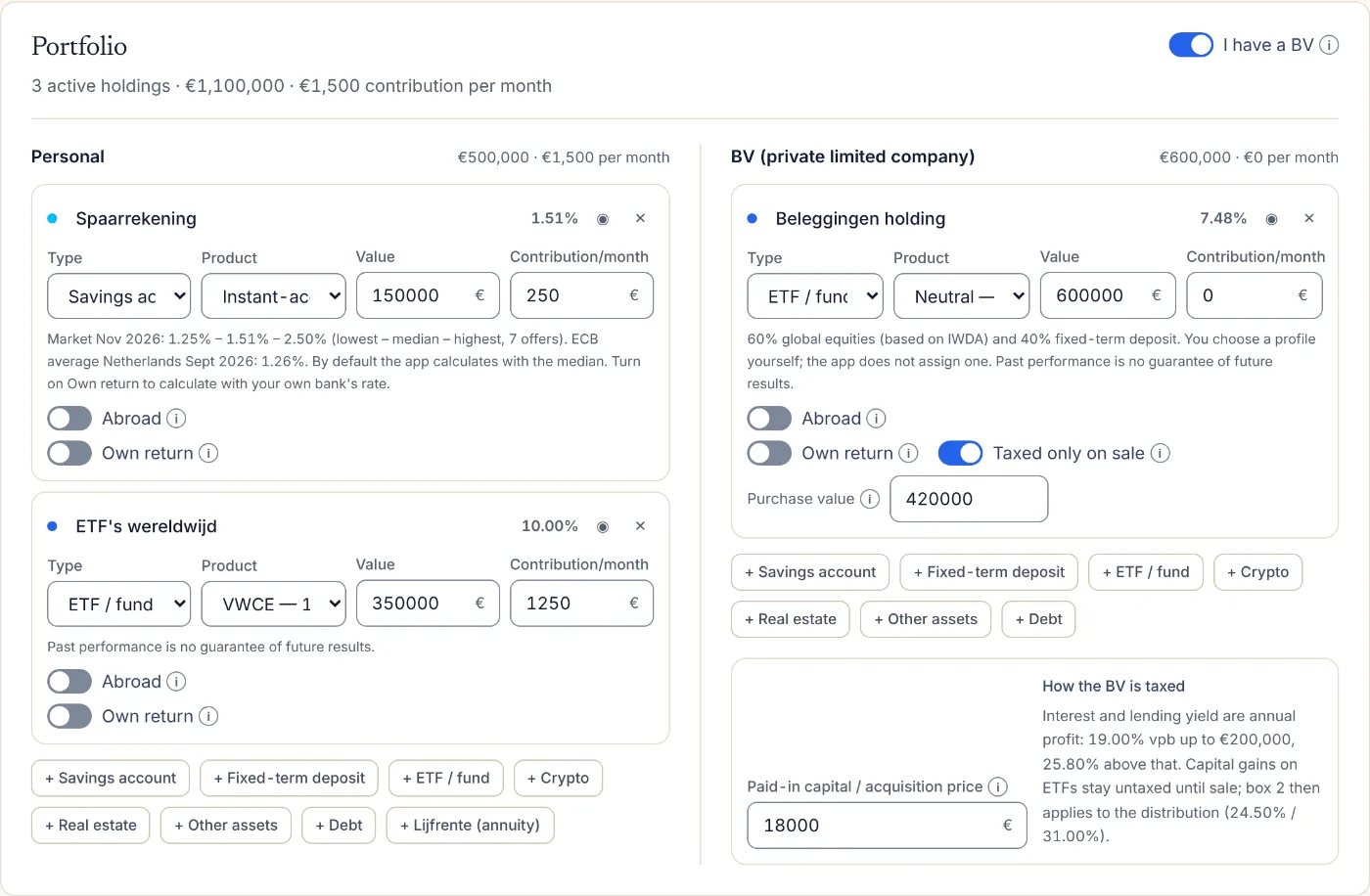
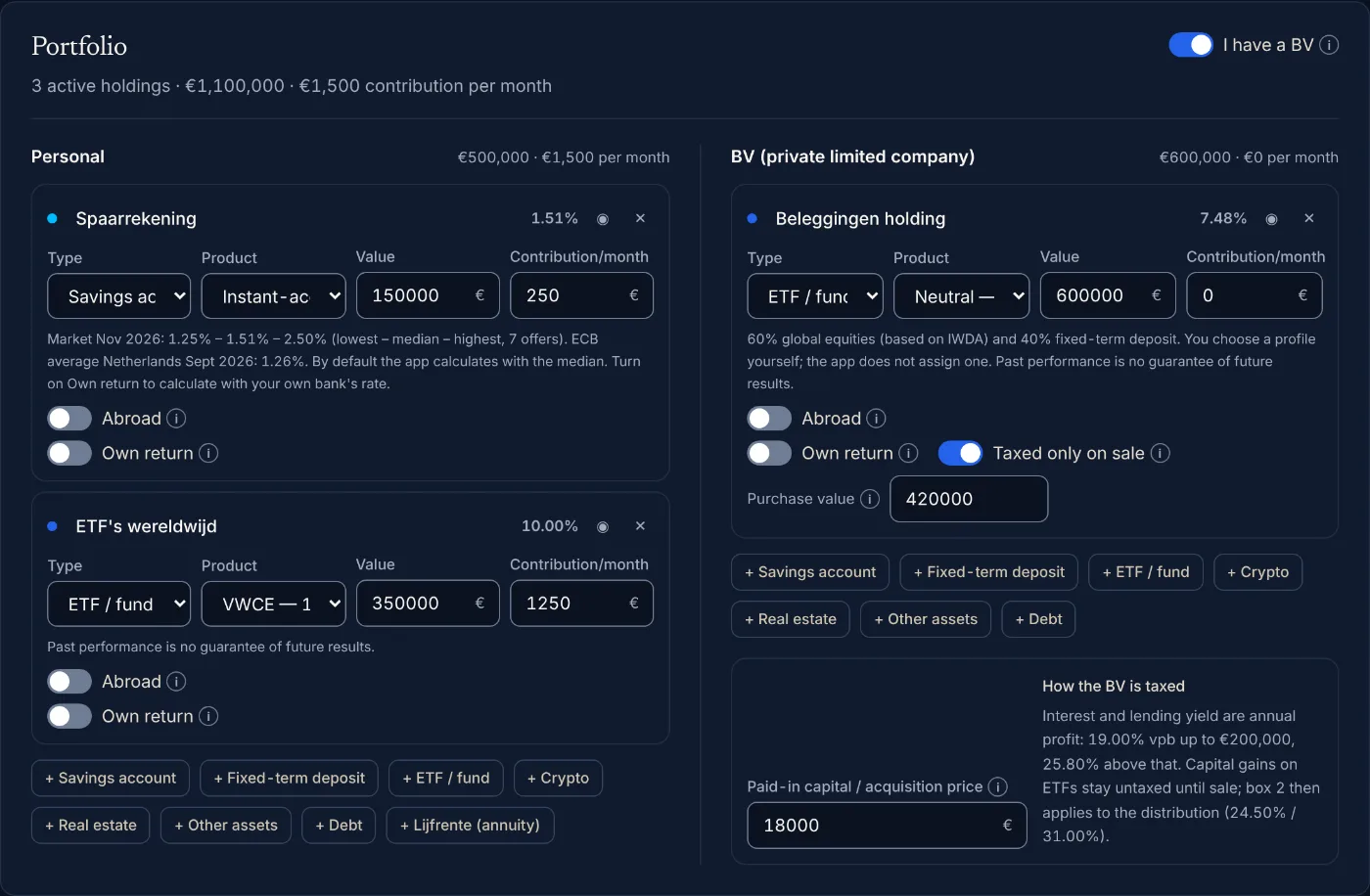
Switch on I have a BV in the portfolio. You then get a second pot next to your personal wealth, with its own holdings: savings, fixed-term deposits, ETFs, real estate or a debt. For each investment you enter the purchase value, so the app knows how much capital gain is still in it, and for the whole BV your paid-in capital.
A report for your adviser
With large amounts and rules that change often, you want your plan checked by your accountant or a tax adviser. With Report (PDF) at the top of the app, you make a summary on A4 for that: your starting points, your portfolio per pot, the key figures, the projection per year, the tax you pay and the tax still locked in your wealth, your BV and the drawdown, the Monte Carlo simulation and the stress tests, and the withdrawal order. If the cabinet plans are switched on, the report says which ones, and what they change compared with current law. You print the report from your browser; your data does not come to us.
See a sample report (PDF) (5 pages). It is an example with made-up figures: age 45, stopping at 55, €150,000 in savings and €350,000 in ETFs personally, a BV with €600,000 in investments, and €3,000 spending per month. There is also a Dutch version.
Who is Pro for?
- A director-major shareholder (dga) with a BV or holding company holding wealth that has to come to you after your FIRE date. You want to know how much is left after vpb and box 2, over how many years to pay out, and what the box 2 plans mean for you.
- A property investor. Pro calculates real estate with loan parts, rent and transfer tax (overdrachtsbelasting), personally or in your BV.
- Anyone who wants to discuss their plan with an adviser. The report puts everything on paper, with the assumptions.
If you only save and invest personally, the free version is enough. If you have debts or a lijfrente, or you calculate together with your partner, that is in Plus. What is in which version is on the page Free, Plus or Pro.
Sources
- Government of the Netherlands (Rijksoverheid): tax key table 2027, vpb and box 2 in 2027 (in Dutch)
- House of Representatives: amendment by Klaver and Dassen (37022, no. 80), box 2 bracket limit frozen from 2027 to 2031, adopted on 12 November 2026 (Word, in Dutch)
- Dutch Tax Administration (Belastingdienst): substantial interest (in Dutch)
- AAFF: corporate income tax rates, 2026 (in Dutch)
- Taxcount: substantial interest, box 2 in 2026 (in Dutch)
- House of Representatives (Tweede Kamer): the amending bill for box 3, parliamentary paper 37053 (in Dutch)
- House of Representatives: explanatory memorandum to the amending bill, section 2.5 (box 2 and borrowing from your BV) (in Dutch)
- House of Representatives: cabinet letter of 3 November 2026 (in Dutch)
A calculation aid, not financial advice. Tax figures for 2026 and 2027 and the amending bill of 3 November 2026, updated on 4 November 2026. Amounts rounded to whole euros. The screenshots and the sample report use made-up figures.